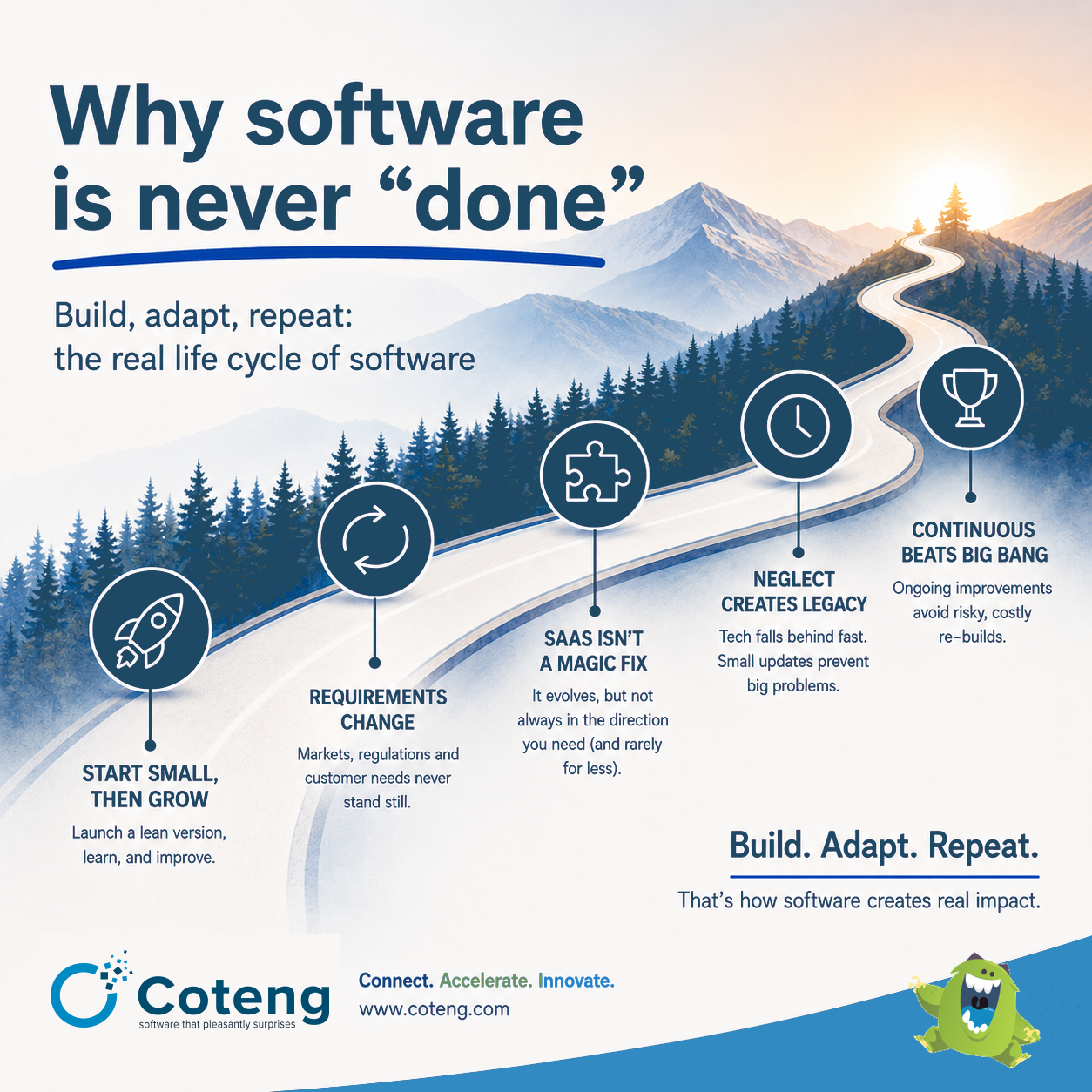
Build, adapt, repeat: the real life cycle of software
Somewhere along the way, businesses got sold a myth: build the software, launch it, move on. Reality looks nothing like that. The organisations that get the most value from technology treat it as an ongoing process, not a one-time project. Here's why.
Start small, then grow
The most successful software projects don't start by trying to build the perfect solution. They start with a Minimum Viable Product - a lean version that solves the core problem - and grow from there.
There's a good reason for this. It's nearly impossible for users to list every requirement upfront. And even when they try, their needs shift the moment they start actually using the tool. Trying to nail everything in version one doesn't just slow things down, it often produces a solution built for a future that's already changed by the time it ships. Getting something useful into users' hands fast, then improving it based on real feedback, simply works better.
Requirements don't stand still
Markets shift. Legislation changes. Business strategies pivot. New technologies emerge. Customer expectations keep climbing. None of this is going away, if anything, it's accelerating. And yet, a lot of companies still treat software implementation as a one-off project: build it once, and expect it to hold for five or ten years. That mismatch, static software in a moving business, is where problems start.
The SaaS illusion
SaaS platforms were pitched as the fix for all of this: always up to date, no maintenance required. In practice, it's more complicated. SaaS tools do evolve but not always in the direction your business needs. Sometimes they add features you never asked for and now have to pay for (when was the last time a SaaS subscription got cheaper over time?). And if you've invested time customising a SaaS platform, you've probably already run into this: an update rolls out, and suddenly your customisations no longer work.
Neglect turns everything into legacy
Here's an uncomfortable truth: without regular maintenance, every application becomes legacy software. In a fast-moving tech landscape, an application can start falling behind within a year of launch. Every application is built on a programming language, and usually leans on external libraries for common functionality. Both keep evolving. The protocols and techniques it uses, for communication, integration, security, evolve too.
Update regularly, in small steps, and staying current is manageable, often folded right into the process of adding new features. Wait too long, though, and the gaps between versions widen. Each step becomes bigger, harder, and riskier. The longer you postpone it, the steeper the climb.
The companies that get it right
The organisations that succeed with automation don't treat modernisation and new functionality as separate tracks. They run both continuously, side by side.
The alternative is a familiar and costly pattern: companies that only add features sporadically, or freeze development entirely, eventually hit a wall. Every five to fifteen years, they're forced into a from-scratch rebuild, not just recreating what they had, but also absorbing every requirement that's piled up in the meantime. What starts as a technical debt becomes an unmanageable mega-project: expensive, risky, and often years behind schedule before it even ships.
Conclusion
Software isn't a monument you build once and admire. It's closer to a garden, it needs regular attention to stay healthy. Businesses that embrace continuous, incremental improvement avoid the trap of massive, high-risk rebuilds and stay genuinely aligned with what their users and market actually need. The choice isn't between change and stability, it's between small, manageable changes now, or one enormous, disruptive change later.

