Improve performance
In every company, there is a permanent need to improve efficiency. Whether the methodology is Continuous improvement, Lean or SixSigma, the ultimate goal is always the same: to improve company performance. These methodologies typically lead to small or large process improvements, based on real-life feedback from employees or insights from data systems. However, as a lot of these processes become automated or software-driven, implementing these improvements increasingly depends on the flexibility of the underlying systems.
Market changes
Marketdynamics are another important driver of change.
Companies are confronted with customers, both B2B or B2C, whose expectations evolve rapidly. For many years now, having a good product alone has no longer been sufficient to succeed. Customers also expect services and support in line with the experiences they have in other areas of their lives. The same applies to employees: they expect company tools to be as user-friendly as the digital tools they use privately.
On top of this, recent geopolitical and economic evolutions have shown that companies must be able to adapt much faster to external factors or their future may become unsure.
Continuous improvement
Against this background, it is remarkable to see that in most companies software systems are still handled as 'one time projects’ : an implementation phase and some support contract. In reality, they should be considered continuous work in progress. Companies that look forward and consistently meet customer needs do not wait to compile an improvements list to define changes and plan them in the next year’s budget. Instead, they anticipate ‘potential change’ and already reserve funding for requirements that will only emerge during the year. This is a process they will repeat year after year because change never stops.
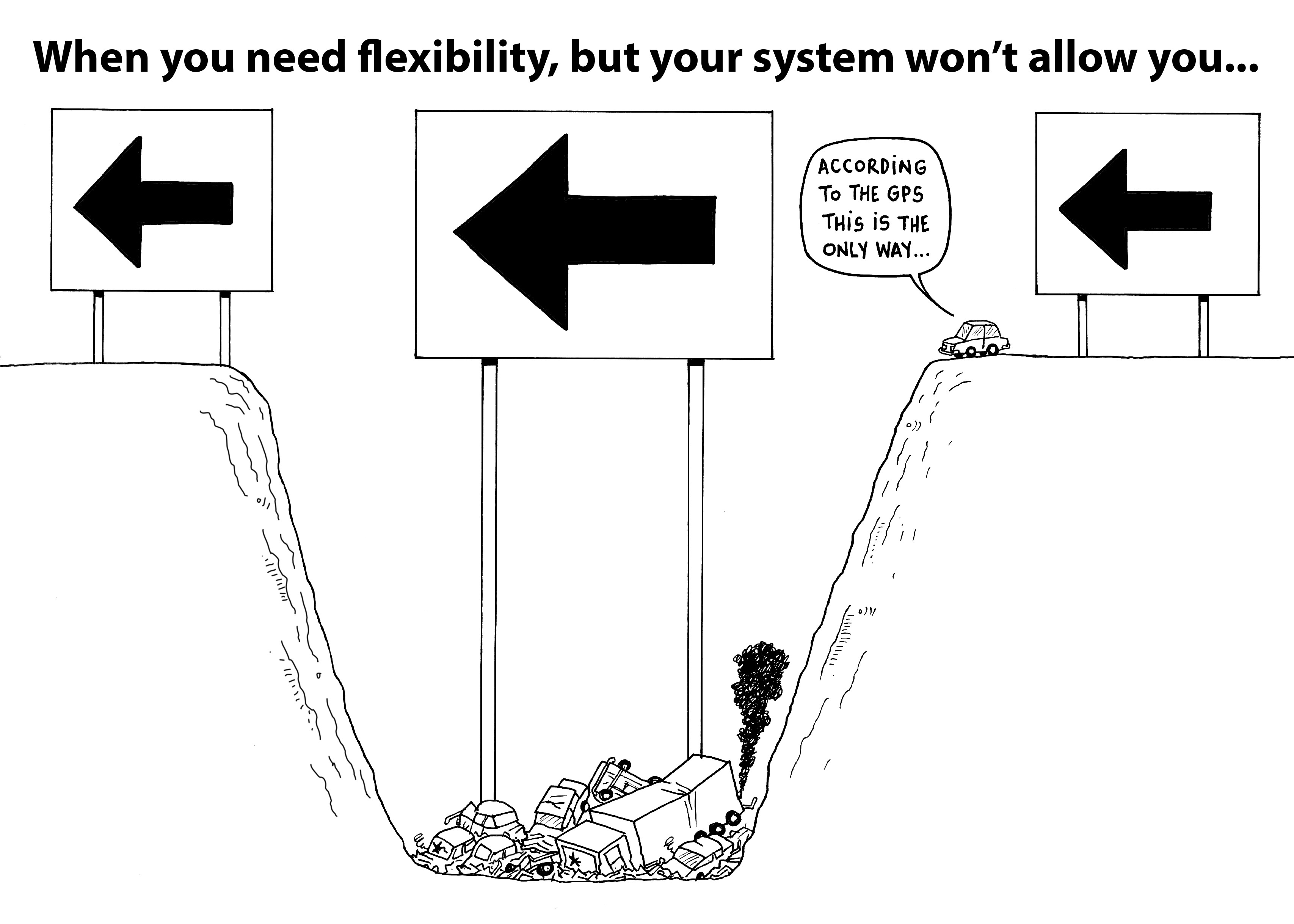
How often have you heard someone say “We should do this, but the system is not capable of doing so” ? At that point, people either give up or start developing creative workarounds that bypass the company system.
Strong partnership
Successful companies therefore work with partners who can handle change fast, typically within three months, and who are organised to implement in a continuous way. Projects that take one or two years before a first version is released, are often outdated by the time they are finished. Yet, a lot of companies still treat a software system as a one-time project effort that is supposed to last for the next five to eight years. When initiating such projects, companies spend months selecting a system, without giving enough attention to one crucial requirement: adaptability.
What seems like the best solution today may no longer fit tomorrow’s needs. In a world of constant change, flexibility is no longer a luxury, it is a strategic necessity.

